

Few modern cannabis names are as instantly recognisable as Blue Dream. Its reputation rests on an inviting combination: Blueberry x Haze genetics, ripe berry sweetness, a bright sativa-leaning character and enough physical softness to keep the experience rounded. Closely tied to California and West Coast strain culture, Blue Dream has survived wave after wave of new releases without losing its place in the conversation.
Its two-parent story explains much of that staying power. Blueberry supplies the plush fruit profile and gentler body character; Haze brings lift, stretch and a thread of citrus, spice and herb. Together they produce a hybrid that can feel more animated than a heavy indica and more approachable than an uncompromising Haze. That balance made the Blue Dream weed strain easy to recommend, easy to remember and remarkably adaptable to different breeder interpretations.
This Blue Dream strain review and grow guide looks beyond the familiar name. It explores the debated origin story, the contribution of both parent lines, aroma and effects, then moves into practical details such as flowering time, stretch, yield potential and phenotype variation. It also shows how to compare Blue Dream feminized and autoflowering seeds before choosing a version for your space, schedule and priorities.
🌱 Shop Blue Dream Seeds:
Blue Dream Feminized Seeds •
Blue Dream Autoflowering Seeds
Table of Contents
🌿 Quick Summary of the Blue Dream Strain
| Type | Sativa-dominant hybrid |
| THC | Typically medium to high; some breeder versions list approximately 17–24% |
| Lineage | Blueberry x Haze |
| Flavours | Blueberry • Sweet berry • Haze • Citrus • Herbal spice |
| Effects | Uplifting • Balanced • Creative • Relaxed |
| Flowering Time | Around 8–10 weeks for many photoperiod versions |
| Yield | Medium to high; depends on breeder selection and environment |
| Difficulty | Beginner to intermediate, with stretch and aroma management required |
| Seed Types | Feminized and autoflowering; specifications vary by breeder |
Blue Dream specifications vary by breeder and phenotype. Always check the exact seed listing before buying.
📜 History & Origins of Blue Dream
Blue Dream belongs to California in the popular imagination. It is woven into the story of West Coast dispensaries, indoor grow rooms and the period when named varieties began reaching a much wider public. Yet its fame is far better documented than its birth. There is no universally accepted account naming a single breeder, exact year or definitive first seed line, and many origin stories blend first-hand memory with later retelling.
What remains consistent is the strain’s association with Blueberry and Haze. The pairing arrived with exactly the right character for the dispensary era: brighter and more energetic than a heavy indica, but softer and less austere than many old-school sativas. Blue Dream occupied the useful middle ground—distinctive enough for enthusiasts, accessible enough for someone encountering named cannabis varieties for the first time.
The name did some of the work too. “Blue Dream” is concise, evocative and perfectly matched to a sweet berry aroma. People could connect the name with the flavour after a single encounter. As California’s cannabis market expanded, that identity travelled from grow rooms to dispensary menus, seed catalogues, online databases and mainstream strain culture. Blue Dream was no longer merely a local favourite; it became a shorthand for a polished, fruit-led, sativa-dominant hybrid.
Success inevitably brought variation. Today, “Blue Dream” may describe an original clone-associated expression, a seed recreation built around Blueberry x Haze, or a breeder’s selected interpretation of the same idea. Those versions can differ in height, flowering time, aroma, potency and the balance between berry softness and Haze brightness. The name is a useful starting point, but the breeder, stated lineage and product specifications reveal what is actually in the pack.
🧬 Blue Dream Genetics & Lineage

Blue Dream is widely associated with Blueberry x Haze genetics, combining fruit-led Blueberry character with uplifting Haze influence.
The accepted shorthand for Blue Dream genetics is Blueberry x Haze. On paper it looks simple; in the plant, the combination joins two very different traditions. Blueberry made fruit a defining part of strain identity, while Haze brought the stature, brightness and aromatic edge of an old-school sativa line.
Blueberry Parent Heritage
Blueberry belongs to the old school of fruit-forward cannabis genetics. Its lasting achievement was not merely producing sweetness; it helped establish flavour as a central part of a strain’s identity. Berry aroma, soft fruit and an almost dessert-like familiarity gave growers and consumers something immediately recognisable in an era when earthy, skunky and herbal profiles were more dominant.
In Blue Dream, that heritage provides the inviting first impression. It is associated with the blueberry and mixed-berry notes at the centre of the aroma, along with a softer, more relaxing body character that rounds the sharper edges of the Haze side. Blueberry-leaning phenotypes may appear broader, sweeter and more compact, although colour, structure and aroma still vary from plant to plant.
Haze Parent Heritage
Haze comes from a different tradition: old-school sativa influence associated with mental lift, height, vigorous stretch and layered aromas of citrus, spice, incense and green herbs. It explains why Blue Dream is not simply a sweet, indica-style berry strain. Beneath the fruit is a brighter aromatic current and a more energetic growth pattern.
That influence is visible in the grow room. Haze can add longer internodes, stronger vertical movement after flowering begins and a finish that takes more patience than compact indica lines. It also gives Blue Dream much of its brightness and creative reputation. Haze-leaning phenotypes may stand taller, smell spicier and need longer to mature, but they are a major reason the strain feels lively rather than merely sweet.
The attraction lies in the tension between them. Blueberry makes the profile welcoming; Haze gives it altitude and momentum. Modern versions may use selected Haze lines, backcrosses or autoflowering genetics, so the exact Blue Dream lineage and the balance of parent traits can differ considerably between seed releases.
🌟 Why Blue Dream Became So Famous
- Recognisable Blueberry x Haze lineage
- Sweet berry flavour with a more complex haze and citrus background
- A balanced reputation that brings uplift and relaxation together
- Broad appeal for both newer and experienced buyers
- Strong California and USA genetics identity
- Commercial availability in feminized and autoflowering seed forms
- Useful indoor and outdoor potential in suitable legal environments
- A grow profile that combines useful vigour with a manageable hybrid flowering window
Blue Dream has remained relevant because its identity is clear. People remember the name, understand the basic flavour promise and can quickly place it between fruit-heavy hybrids and more demanding Haze varieties. It is also commercially adaptable: breeders can emphasise the original photoperiod profile, create an autoflowering interpretation or select for a particular balance of height, speed, flavour and potency.
🌱 Blue Dream Seeds – Feminized, Autoflower & Breeder Options
Buying Blue Dream seeds is less about finding one universally “correct” pack and more about finding the version that matches your priorities. A release may be a Blueberry x Haze recreation, a selection intended to echo a well-known cut or a breeder’s own interpretation. Before ordering, check six details: breeder, lineage, seed format, flowering time or total life cycle, expected height and yield, and stated THC range.

Blue Dream seeds are available in feminized and autoflowering formats, with specifications varying by breeder.
Blue Dream Feminized Seeds
Feminized photoperiod seeds are the natural choice for buyers who want the traditional Blue Dream growing format. Flowering begins after the light cycle changes, leaving the grower in control of vegetative time. That extra control is valuable: a shorter vegetative phase can help contain height, while a longer one can build a larger framework before flowering where space and local law allow.
The trade-off is planning. Blue Dream’s Haze side can produce noticeable stretch after the switch to flower, so indoor growers need headroom and may need branch support. Outdoors, a warm, sunny season and a suitable finishing window matter. Many photoperiod versions quote roughly 8–10 weeks in flower, though a Haze-leaning phenotype can take longer.
👉 Buy Blue Dream Feminized Seeds
Blue Dream Autoflowering Seeds
Autoflowering versions combine a Blue Dream-style profile with age-triggered flowering. They do not wait for a light-cycle change, which makes the schedule easier to understand and often shortens the journey from seed to harvest. For buyers working with a limited season or simply wanting fewer timing decisions, that simplicity can be the main attraction.
The key comparison is the breeder’s stated total life cycle, not the flowering figure used for a photoperiod plant. Autos also have less time to recover from setbacks, so a stable start matters. Check expected height and yield as carefully as speed: the fastest version is not automatically the best fit.
👉 Buy Blue Dream Autoflowering Seeds
How to Choose Between Blue Dream Seed Versions
| Compare | Feminized Photoperiod | Autoflowering |
| Flowering trigger | Light-cycle change | Plant age |
| Planning focus | Flowering weeks and vegetative time | Total seed-to-harvest cycle |
| Size control | More control through vegetative timing | Usually a shorter fixed development window |
| Best fit | Growers seeking the traditional format and training flexibility | Growers prioritising a simple schedule or faster cycle |
Blue Dream also sits naturally within Classic Strains, Cali Strains, Feminized Seeds and Autoflower Seeds. Those collections can help buyers compare Blue Dream with other seed formats and genetic styles without assuming every product performs the same way.
In short, choose feminized seeds when control over vegetative time, training and final size matters most. Choose an autoflower when an age-triggered schedule and total-cycle simplicity matter more. In either format, the breeder’s specifications—not the Blue Dream name by itself—should make the final decision.
👃 Blue Dream Aroma, Flavour & Terpenes
Flavour is central to the lasting appeal of the Blue Dream weed strain. The first impression is usually blueberry or mixed sweet berries, but the profile does not stop at fruit. Haze adds a dry, lifted edge, while citrus, green herbs and light spice create a finish with more shape than a simple candy sweetness. Some phenotypes lean towards ripe berries; others reveal more incense, pine or pepper.
The signature aromatic notes include:
- Blueberry and sweet berry
- Soft fruit sweetness
- Haze and light herbal character
- Citrus brightness
- Spice or pepper in the finish
Terpene profiles often feature myrcene, pinene, caryophyllene and limonene, but there is no fixed Blue Dream formula. Breeder selection and phenotype matter, as do cultivation conditions, harvest timing, drying and storage.
That variation explains why one Blue Dream sample may smell like fresh berries and citrus while another presents more pine, herb or pepper. The shared expectation is a sweet fruit foundation with enough Haze complexity to keep it from becoming one-dimensional.
💨 Effects of Blue Dream Weed
Blue Dream built its reputation on contrast: uplifting and creative at the front, smoother and more relaxed underneath. Many users describe a bright mental opening that settles into physical ease without immediately becoming heavy. That shape places it far from the classic couch-lock stereotype and helps explain its unusually broad appeal.
The experience is often characterised by:
- An upbeat or euphoric mood
- Creative, conversational or idea-oriented energy
- A smoother body character beneath the cerebral effect
- A more balanced profile than many very heavy indicas
- Less aggressive intensity than some Haze-dominant varieties
Cannabis effects are subjective. Potency, serving size, tolerance, individual sensitivity, setting and phenotype can all change the experience. Treat a stated THC figure as information about that particular release, not a promise about every plant or person.
🌱 Blue Dream Grow Guide & Strain Characteristics
Blue Dream is a vigorous, sativa-dominant hybrid with strong branching, noticeable stretch and generous yield potential. Those traits are connected: flowering time affects final height, Haze influence shapes the structure, and seed format determines whether the grower controls the transition into bloom. A useful grow profile therefore has to consider the whole plant rather than reducing it to a single week count.
Legal note: This grow guide is for adults in regions where cannabis cultivation is legal. Always check and follow your local laws before germinating seeds.
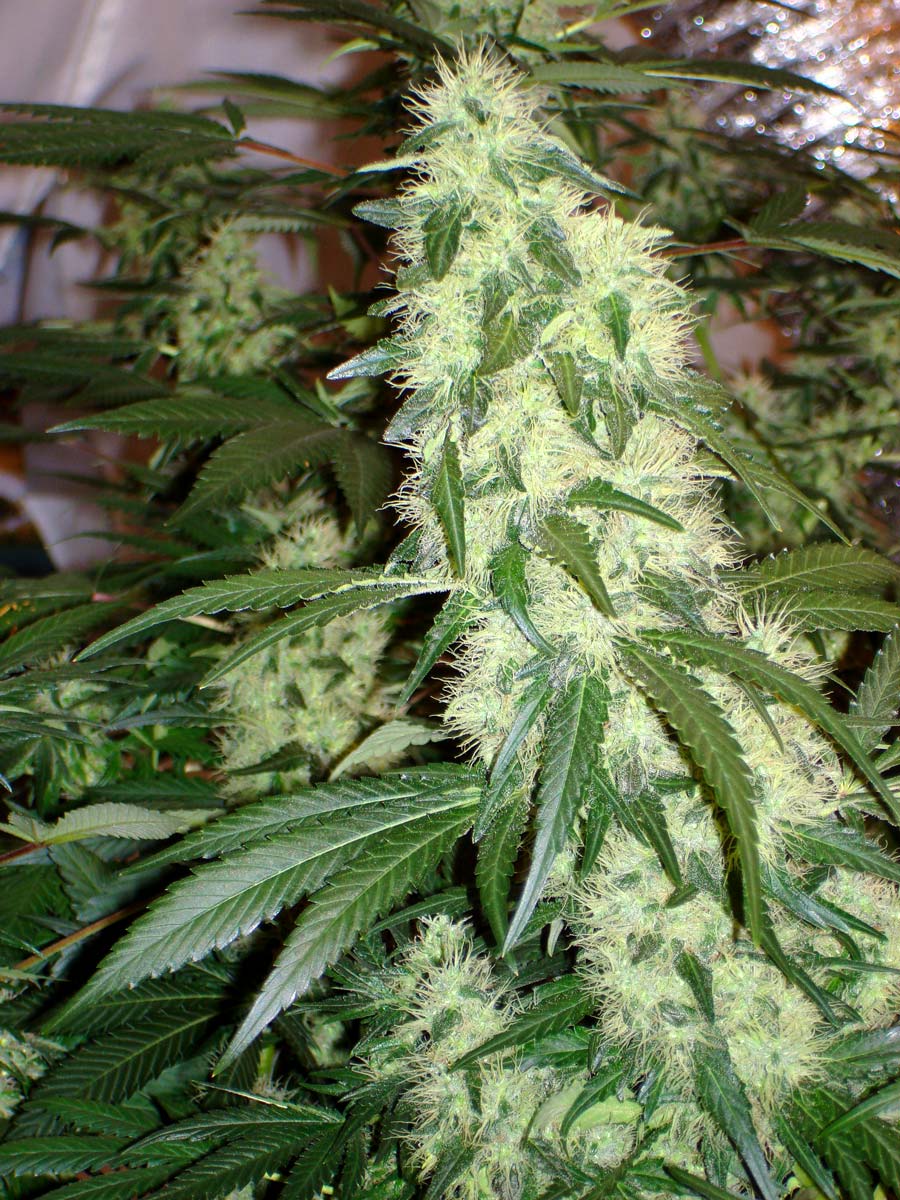
Blue Dream is often described as a sativa-dominant hybrid with strong growth, sweet aroma and generous yield potential.
Blue Dream Flowering Time
Most photoperiod Blue Dream versions place the flowering window at approximately 8–10 weeks, with 9–10 weeks a frequent expectation. That figure begins when flowering starts; it does not include germination or the vegetative period. Indoors, the grower decides how long to vegetate before changing the light cycle. Outdoors, latitude, seasonal daylight, phenotype and weather determine when the plant begins and finishes bloom.
Autoflowering Blue Dream runs on a different clock. Auto listings usually quote a total cycle from seed, so an auto’s schedule should never be compared directly with the flowering-only figure of a photoperiod plant. Read the exact product specification and check whether the stated number means “in flower” or “from seed to harvest.”
Indoor and Outdoor Suitability
Blue Dream can perform indoors or outdoors, but each setting asks a different question. Indoors, can the space absorb its vertical movement once flowering begins? The Haze side can push branches upwards quickly, making headroom, canopy shape and support more important than they would be for a compact indica. Outdoors, the question is whether the season is warm, bright and long enough for the selected photoperiod phenotype to finish comfortably.
Humidity, temperature, light intensity, root space and local season all influence the final plant. An indoor setup offers more environmental control; a suitable outdoor position offers space for Blue Dream’s natural branching and height. In either case, match the breeder’s expected finish to the real conditions available.
Height, Stretch and Structure
Expect a sativa-influenced frame rather than a short, squat indica. Blue Dream tends to build vigorous side branches, medium-to-tall height and more space between nodes. That stretch can be an advantage when a broad canopy is wanted, but it can catch out anyone who assumes the plant will stay compact after flowering begins.
Parent expression is easy to see in the structure. A Blueberry-leaning plant may remain broader, sweeter and somewhat more compact; a Haze-leaning plant may be taller, airier and slower to finish. When growing several seeds, do not assume every plant will stretch or mature at exactly the same rate.
Yield Potential
Blue Dream carries a well-earned reputation for medium-to-high yield potential. Its vigour, branching and ability to build a broad flowering framework all contribute. Published indoor and outdoor figures are useful for comparing releases, but they are targets achieved under particular conditions—not a promise for every plant.
Final yield depends on light, root space, plant health, vegetative time, climate and phenotype. A larger structure can carry more flower, but it may also need support late in bloom. This is especially true when Haze-like reach meets heavier flower development along long lateral branches.
Difficulty Level
Blue Dream sits in a useful middle category: approachable for a prepared beginner, yet interesting enough for an experienced grower to select and shape. It is generally less demanding than a very long-flowering Haze, and its vigour can help it recover from minor mistakes. The main challenge is not fragility but scale—height, branching, aroma and differences between phenotypes.
The main considerations are:
- Allowing room for stretch
- Maintaining airflow through a branching canopy
- Supporting longer or heavier branches where needed
- Managing a noticeable sweet aroma during flowering
- Checking plants individually because phenotypes may finish at different times
Climate Preference and Flowering Aroma
Outdoors, Blue Dream favours warmth, abundant light and a season with enough time to finish—conditions often described as Mediterranean-style. Indoors, a stable environment can provide the same consistency without relying on the weather. As flowers develop, the aroma can become much stronger than the plant’s gentle name suggests: berry sweetness thickens while citrus, haze and spice become more pronounced. Where cultivation is legal, odour control should be planned before bloom rather than added as an afterthought.
Why the Haze Influence Matters
Haze is the reason Blue Dream grows with more reach and takes more patience than a fast, compact indica. It contributes the longer internodes, early-flower stretch and the possibility of a later-finishing phenotype. Yet Blue Dream usually stops short of the most demanding Haze extremes. Well-selected versions offer an appealing compromise: sativa brightness and structure, Blueberry sweetness, productive branching and a photoperiod flowering window that often remains within roughly 8–10 weeks.
🔗 Related Strains & Seed Collections
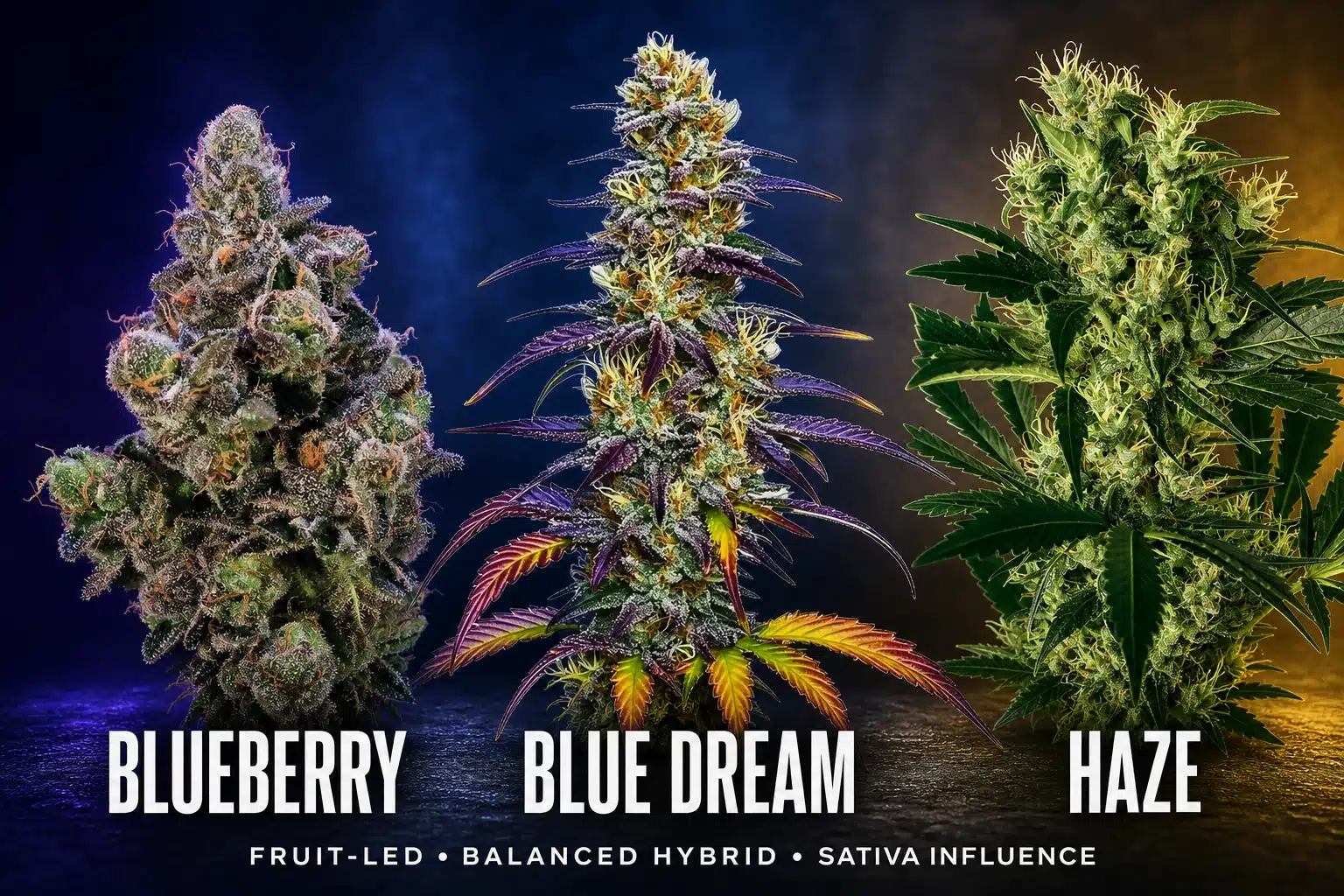
Blue Dream sits between fruit-led Blueberry genetics and uplifting Haze influence, making it a useful comparison point for classic and Cali-style strains.
Blue Dream is most useful as a comparison point between classic fruit genetics and modern West Coast hybrids. If its profile appeals to you, explore:
- Classic & Old-School Strains for established names and heritage-style profiles
- Cali Strains & USA Genetics for West Coast-influenced breeding
- Feminized Seeds for photoperiod options from multiple breeders
- Autoflower Seeds for age-triggered, often quicker-cycle options
- High THC Seeds when stated potency is a primary comparison point
- Beginner-Friendly Seeds for varieties selected around approachable grow characteristics
- High Yield Seeds when productive potential is the main priority
Blueberry fans may prefer expressions with deeper fruit and a softer body character. Haze fans may gravitate towards phenotypes with greater stretch, citrus, spice and cerebral lift. Jack Herer, Super Silver Haze and Sour Diesel offer other reference points for bright, aromatic sativa-influenced profiles, while Blue Dream remains the fruitier and more rounded proposition.
⚠️ Possible Side Effects
- Dry mouth
- Dry eyes
- Dizziness in some users
- Stronger or less comfortable effects at higher intake levels
Responses vary by tolerance, potency, serving size and individual sensitivity. Start cautiously where adult use is legal, and do not drive or operate machinery while impaired.
❓ Blue Dream Strain FAQs
What is the Blue Dream strain?
Is Blue Dream indica or sativa?
What are Blue Dream genetics?
What does Blue Dream taste like?
What are Blue Dream effects?
What is Blue Dream THC content?
What is the Blue Dream strain flowering time?
What Blue Dream grow information should beginners know?
Is Blue Dream easy to grow?
Are Blue Dream feminized seeds available?
Are Blue Dream autoflower seeds available?
Can I buy Blue Dream seeds online?
Is Blue Dream a Cali strain?
How does Blue Dream compare with Blueberry?
How does Blue Dream compare with Haze?
Is it legal to buy Blue Dream seeds?
⚖️ Legal Information
Cannabis seeds are sold as adult souvenirs, collectibles or for genetic preservation where cultivation is restricted. Laws vary by country, state and region. Customers are responsible for checking local regulations before purchasing or germinating seeds.
🏁 Final Thoughts
The Blue Dream strain remains a cornerstone because it brings several enduring ideas together in one memorable name: famous Blueberry x Haze genetics, sweet fruit flavour, balanced character and a strong California identity. It is modern enough to feel at home among Cali strains yet established enough to belong beside classic genetics.
Its wide availability also gives buyers genuine choice. A feminized photoperiod version can suit someone seeking the traditional format and more control over plant development, while an autoflowering version can suit someone prioritising a simpler schedule or faster total cycle. In both cases, breeder selection matters more than the name alone.
For anyone comparing Blue Dream flowering time, yield or grow characteristics, the most useful approach is to begin with the common profile—sativa-dominant, vigorous, berry-led and typically medium to high yielding—then confirm every important figure on the exact product listing. That combination of recognisable identity and breeder-level choice is why Blue Dream continues to attract growers, collectors, strain researchers and seed buyers.
🌱 Choose Your Blue Dream Seeds:
Buy Blue Dream Feminized Seeds •
Buy Blue Dream Autoflowering Seeds