
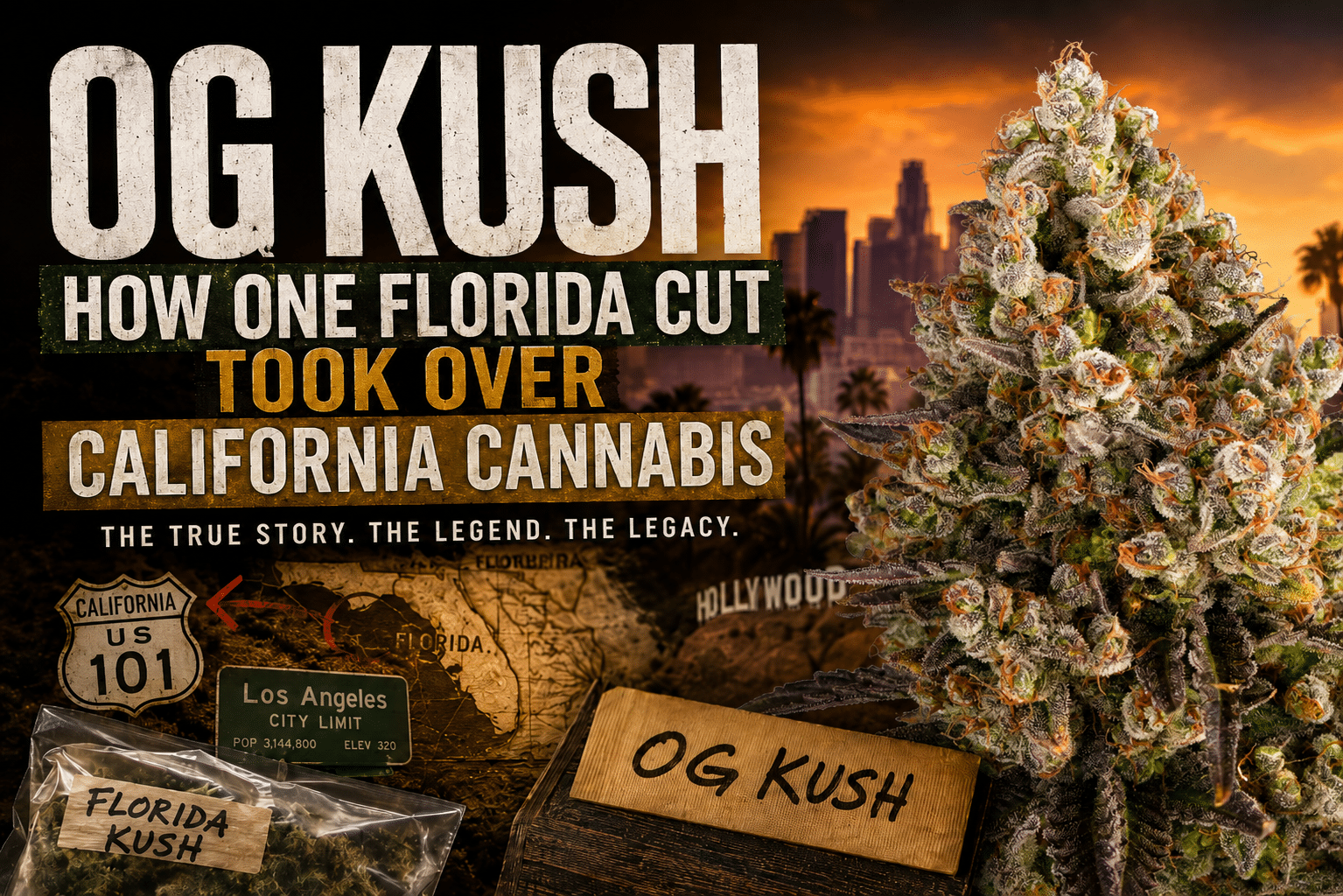
Before Cookies, Gelato, Runtz and Zkittlez, there was OG Kush. From mysterious Florida roots to Hollywood grow rooms and West Coast legend status, this is the story of the clone that changed modern cannabis forever.
The Strain That Ruled California
Before Cookies.
Before Gelato.
Before Runtz.
Before Zkittlez.
There was OG Kush.
In the late 1990s and early 2000s, if you wanted the best cannabis in California, one name kept coming up again and again.
OG Kush.
It wasn’t the easiest plant to grow.
It wasn’t the biggest yielder.
It wasn’t the most stable.
But once people experienced it, none of that seemed to matter.
The aroma was louder.
The flavour was sharper.
The effect was heavier.
The reputation spread faster than almost anything else in modern cannabis history.
Growers built entire businesses around it. Rappers mentioned it. Collectors chased it. Breeders crossed it into everything they could get their hands on.
Within a few short years, OG Kush had become more than a strain.
It became a standard.
A name people used when they meant elite.
A genetic line that would help shape the future of cannabis across California, the Emerald Triangle, Europe and eventually the world.
Today, OG Kush genetics can be found in countless modern hybrids, from classic OG descendants to Chem-family crosses such as Chem4 OG seeds.
Yet despite its fame, the true story of OG Kush remains surprisingly messy.
Florida or California?
Chemdog or Hindu Kush?
Original Gangster or Ocean Grown?
One thing is certain.
Somewhere between Florida, Los Angeles and Northern California, a single surviving cut became one of the most influential cannabis plants ever preserved.
The Florida Origins
Most cannabis legends begin in California.
OG Kush is different.
The story appears to begin on the other side of the country, in Florida, during the early 1990s.
At the centre of the story is a grower named Matt “Bubba” Berger.
Berger was already known locally for working with standout cannabis genetics, including a Northern Lights-related plant that would later become associated with Bubba Kush.
But the plant that changed everything was something else entirely.
At the time, it wasn’t called OG Kush.
It wasn’t even called Kush in the way people use the term today.
According to the most repeated version of the story, Berger came across an exceptional Florida cut known as Krippy or Kryptonite.
The flowers were dense, colourful and unusually powerful for the era.
Someone reportedly described the buds as looking like Kushberries.
The name stuck.
Kushberries became Kush.
And that Florida Kush would eventually become one of the most famous plants in cannabis history.
The irony is that the name may not originally have had anything to do with the Hindu Kush mountains.
It may simply have been a nickname given to unusually dense, colourful, high-quality flower.
Over time, however, the word Kush would become almost inseparable from cannabis culture.
And OG Kush would become the strain that made the word famous.
Krippy, Kushberries and the Birth of a Name
To understand why OG Kush became so important, you have to understand what cannabis looked like before it arrived.
In the early 1990s, elite clone-only genetics were not easy to access.
The modern seed market did not exist in the way it does today.
Growers traded cuts quietly.
Stories travelled by word of mouth.
Names changed depending on who had the plant, where it was grown and who was telling the story.
That is one reason OG Kush history is so difficult to pin down.
It passed through a world that was deliberately undocumented.
No breeder catalogue.
No official release.
No neatly printed lineage card.
Just a plant that moved from grower to grower because people recognised it was special.
The Florida Kush cut stood out because it combined traits that were rare to find together at the time.
- Dense resinous flowers
- Powerful aroma
- Strong potency
- Distinctive lemon, pine and fuel notes
- A quality level that made people remember it
It was not simply another good bag of cannabis.
It was the type of plant that created obsession.
People wanted the cut.
Growers wanted to run it.
Smokers wanted more of it.
Before long, that Florida Kush would make its way to California.
That journey would change everything.
The Move to Los Angeles
By the mid-1990s, cannabis culture in California was changing fast.
Los Angeles was becoming a centre of indoor cultivation, underground genetics and medical cannabis momentum.
California’s Proposition 215 would arrive in 1996, opening the door to the first legal medical cannabis market in the United States.
But before the legal market emerged, growers were already building the foundations in basements, bedrooms, garages and hidden grow rooms across the state.
This is where Josh D, also known as Josh Del Rosso, enters the story.
Matt Berger moved to Los Angeles and connected with Josh through a mutual circle.
Berger knew Florida had something California needed to see.
Eventually, he returned east and brought back several important cuts, including Kush, Bubba and other Florida genetics.
According to the story, several small Kush cuttings made the journey west.
Only one survived.
That one surviving plant would become the foundation of OG Kush in California.
It is difficult to overstate how unlikely that sounds now.
One surviving cut.
One grow room.
One small circle of people.
And from that, an entire cannabis dynasty.
The One Clone That Survived
The surviving Florida Kush cut was not a beginner-friendly plant.
In fact, many accounts describe it as difficult, sensitive and demanding.
It could stretch awkwardly.
It did not always yield heavily.
It required attention.
It rewarded growers who learned its habits and punished those who treated it like an ordinary plant.
That is part of why Josh D became so important to the OG Kush story.
He did not merely receive the cut.
He helped preserve it.
He learned how to grow it properly.
He shared it with the right people.
And he helped establish the cultivation knowledge that allowed OG Kush to become more than a rare Florida clone.
Once dialled in, the plant produced flowers that seemed almost unreal for the time.
Dense.
Greasy.
Resin-coated.
Loud with lemon, pine, fuel and earth.
The sort of cannabis that did not need marketing because the flower did the talking.
In Los Angeles, that mattered.
The right strain in the right city at the right moment could travel fast.
OG Kush arrived just as California cannabis culture was ready for something new.
And once people encountered it, the name began to spread.
Part 1 Conclusion
OG Kush did not begin as a polished commercial strain.
It began as a mystery cut.
A Florida plant with an uncertain past.
A nickname that became a movement.
A single surviving clone carried across the country and preserved by growers who recognised its potential.
By the time it reached Los Angeles, the ingredients were already in place.
The genetics.
The growers.
The timing.
The culture.
All OG Kush needed was a spark.
In California, it found one.
The LA Takeover
Los Angeles did not create OG Kush.
But Los Angeles made it famous.
By the mid-1990s, the city was becoming one of the most important cannabis centres in America.
The timing could not have been better.
California was on the edge of medical cannabis reform. Proposition 215 would pass in 1996, creating the first legal medical cannabis framework in the United States.
Before dispensaries became mainstream, however, the real work was happening behind closed doors.
Spare bedrooms.
Garages.
Basements.
Hidden grow rooms.
Small circles of growers sharing elite cuts with people they trusted.
OG Kush entered that world at exactly the right moment.
It was rare.
It was difficult.
It was expensive.
Most importantly, it was unforgettable.
In a city built on reputation, that mattered.
Josh D and the Indoor Revolution
Josh D did not invent OG Kush.
He has been clear about that.
But he played one of the most important roles in the strain’s history.
He preserved it.
He learned it.
He shared it.
And he helped turn a difficult Florida clone into the defining strain of West Coast cannabis culture.
At the time, indoor cultivation was becoming increasingly important.
Outdoor growing carried obvious risks. Large plants could be seen by neighbours, thieves or law enforcement. Helicopters, raids and prohibition-era pressure forced many growers to rethink how cannabis could be produced.
Indoor cultivation changed the game.
It allowed growers to control light, feeding, environment and security in ways that were almost impossible outdoors.
For a plant like OG Kush, that mattered.
The cut was not naturally forgiving.
It needed attention.
It needed the right environment.
It needed someone willing to learn its quirks rather than discard it for an easier plant.
Josh D did exactly that.
He worked out how to grow it properly, how to bring out its quality, and how to make it perform in indoor rooms across Los Angeles.
That cultivation knowledge became almost as valuable as the clone itself.
A great plant is one thing.
A great plant that someone knows how to grow consistently is something else entirely.
The Flower That Sold Itself
OG Kush did not become famous because of advertising.
It became famous because people tried it.
The buds were smaller than some commercial growers wanted.
The plant was not a monster yielder.
But the finished flower had something that most high-yielding strains did not.
Impact.
Open a bag and the aroma filled the room.
Lemon.
Pine.
Earth.
Fuel.
A sharp, penetrating funk that was instantly recognisable.
The effect was equally memorable.
Strong, euphoric, heavy and long lasting, OG Kush quickly built a reputation for quality that moved from grower circles into wider cannabis culture.
People did not just want cannabis.
They wanted OG.
And if someone claimed they had OG, people expected it to be exceptional.
That expectation would eventually become a problem, because almost any good cannabis in Los Angeles started getting called Kush.
But in the beginning, the real cut stood apart.
It had a signature.
It had a reputation.
It had that unmistakable OG presence.
When Kush Became a Word for Fire
Before OG Kush exploded, Kush was not the universal cannabis buzzword it later became.
After OG Kush, everything changed.
In Los Angeles, the word started spreading beyond the original plant.
People used Kush to describe elite flower.
Dealers used it to sell bags.
Growers used it to build hype.
Smokers used it as shorthand for something strong, expensive and worth chasing.
That is one of the clearest signs that OG Kush had crossed from strain into culture.
When a strain name becomes slang, it has done something most cultivars never will.
It has entered the language.
OG Kush did exactly that.
By the late 1990s and early 2000s, Kush was no longer just a plant.
It was a marker of quality.
A status symbol.
A promise.
And in Southern California, no promise carried more weight than OG.
Cypress Hill, B-Real and the Hip-Hop Connection
OG Kush did not rise in isolation.
It rose inside a cultural moment.
Los Angeles in the late 1990s was a perfect amplifier.
Hip-hop was shaping global youth culture.
California cannabis was developing its own identity.
Medical cannabis was beginning to change the conversation around the plant.
And influential artists were helping certain strains become legendary long before social media existed.
Few names matter more in that story than B-Real of Cypress Hill.
Cypress Hill had already helped bring cannabis into mainstream music culture during the 1990s.
When figures like B-Real and other respected West Coast artists became associated with OG Kush, the strain gained a kind of cultural authority that no advert could buy.
This was not polished corporate branding.
It was reputation moving through studios, grow rooms, lyrics, smoke circles and word of mouth.
If the right people said OG Kush was the one, people listened.
And once they tried it, the legend became self-sustaining.
The more exclusive it felt, the more people wanted it.
The more people wanted it, the more valuable it became.
The more valuable it became, the more every grower in California wanted access to the cut.
The $8,000 Pound
At the height of the early OG Kush craze, the numbers became almost mythical.
Stories circulated of OG Kush pounds commanding prices as high as $8,000.
That sounds ridiculous now.
But in context, it makes sense.
Supply was limited.
Demand was enormous.
The quality was undeniable.
And the name carried weight.
OG Kush was not simply expensive cannabis.
It was the cannabis people wanted when they wanted the best.
In an underground market where reputation was everything, scarcity created power.
If you had real OG, you had leverage.
If you could grow it properly, you had a business.
If you could get access to the cut, you had a piece of something much bigger than a single strain.
This is where OG Kush began to shift from local legend to economic force.
It was not just influencing what people smoked.
It was influencing what people grew.
And that would have consequences far beyond Los Angeles.
Queen of Southern California
For a period of time, OG Kush was the undisputed queen of Southern California cannabis.
Other strains existed.
Other strains were popular.
But OG had a hold on the culture that few cultivars have ever matched.
It had the aroma people chased.
It had the potency people remembered.
It had the scarcity people talked about.
And it had the name.
That combination made it almost unstoppable.
Growers who had the real cut guarded it carefully.
Smokers compared everything else against it.
Breeders saw its potential immediately.
Before long, OG Kush was no longer just being grown.
It was being crossed.
Backcrossed.
Renamed.
Reworked.
Copied.
Imitated.
And used as the foundation for an expanding family of OG hybrids.
Some were exceptional.
Some were not.
But the direction was clear.
OG Kush had become the genetic currency of California cannabis.
The First Wave of OG Variants
As OG Kush spread, different cuts and selections began to appear.
Some came from the original clone.
Some came from seeds found in OG bags.
Some were regional selections.
Some were later breeder projects created to capture the OG profile in seed form.
Names like SFV OG Kush, Tahoe OG, Larry OG and Fire OG would eventually become part of the wider OG universe.
Each carried its own story.
Each expressed the OG profile slightly differently.
Some leaned more citrus.
Some leaned more fuel.
Some were heavier, darker and more sedating.
Others kept more of the electric lemon-pine quality that made OG famous in the first place.
That family expansion is one reason OG Kush became so dominant.
It was not a dead-end clone.
It was a platform.
A genetic starting point for an entire generation of cannabis breeding.
Today, collectors can still explore this family through modern seed lines such as SFV OG Kush seeds, Buddha Tahoe OG Kush seeds and Larry OG Kush seeds.
Part 2 Conclusion
OG Kush became legendary because it arrived at the perfect moment.
A rare Florida cut landed in Los Angeles just as indoor cultivation, medical cannabis reform, hip-hop culture and underground genetics were all colliding.
Josh D helped preserve and dial in the plant.
Growers spread it through trusted circles.
Artists and connoisseurs amplified its reputation.
Prices climbed.
Demand exploded.
And before long, OG Kush had become the strain by which other cannabis was judged.
But one question still refuses to go away.
What does OG actually mean?
Original Gangster?
Ocean Grown?
Organic Grown?
Or simply original?
That debate deserves its own chapter.
What Does OG Actually Mean?
Few two-letter combinations have caused more debate in cannabis culture than OG.
Everyone knows the name.
Almost everyone has a theory.
Original Gangster.
Ocean Grown.
Organic Grown.
OverGrown.
Original.
Depending on who you ask, the answer changes.
That is part of what makes OG Kush so fascinating.
Like Chemdog, the strain comes from an era before cannabis history was properly recorded.
There were no official breeder pages.
No seed bank launch announcements.
No Instagram posts.
No QR-coded lab reports.
Just growers, cuts, rooms, stories and reputation.
As OG Kush spread through California, the meaning of the name became almost as famous as the strain itself.
Original Gangster
The most culturally powerful explanation is Original Gangster.
It makes sense.
OG Kush rose to fame in Los Angeles during the same era that West Coast hip-hop was shaping global culture.
The term OG was already widely understood as a mark of respect.
An OG was someone authentic.
Someone established.
Someone who had earned their status.
In that context, OG Kush felt like the perfect name.
It wasn’t just another Kush.
It was the original.
The respected one.
The one with weight behind the name.
As the strain moved through music circles, grower networks and LA cannabis culture, the Original Gangster interpretation became impossible to separate from the legend.
Even today, for many people, OG Kush still means Original Gangster Kush.
Whether that was the first intended meaning is another question.
Ocean Grown
The second major theory is Ocean Grown.
According to this version, OG referred to cannabis grown near the Pacific Ocean.
The idea fits neatly with California mythology.
Coastal air.
Pacific fog.
West Coast growers.
California sunshine.
It sounds good.
It feels believable.
And because OG Kush became so deeply associated with Southern California, the Ocean Grown explanation spread widely.
For years, many cannabis enthusiasts accepted it as fact.
But the problem is simple.
The strongest versions of the OG Kush origin story point back to Florida before the plant ever became a California icon.
That does not completely disprove the Ocean Grown interpretation, but it makes it less convincing as the original meaning.
It may have been a later explanation attached to a strain that had already become deeply connected with the West Coast.
Original, Authentic, Respected
The simplest explanation may also be the most convincing.
OG may simply have meant original.
Not ocean grown.
Not a marketing slogan.
Not a formal breeder name.
Just original.
As Kush became a catch-all term for high-quality cannabis in Los Angeles, the people holding the real cut needed a way to separate it from imitators.
There was Kush everywhere.
But there was only one original.
That original became OG Kush.
In California slang, OG also carried the idea of authenticity, seniority and respect.
That made the name even more powerful.
It said everything without explaining anything.
This was the real one.
The old-school one.
The respected one.
The one everything else was trying to imitate.
Why the Meaning Still Matters
The debate around the name matters because it reflects something bigger about OG Kush itself.
This was not a strain created in a boardroom.
It was not named by a marketing department.
It did not arrive with a polished origin story.
It earned its reputation first.
The name followed.
That is why the debate has lasted so long.
OG Kush belongs to a period of cannabis history where myth, truth and word-of-mouth all overlap.
Sometimes the stories contradict each other.
Sometimes two versions can both contain part of the truth.
And sometimes the mystery is part of the reason people still care.
Whatever OG originally meant, the meaning today is clear.
OG Kush means foundation genetics.
It means West Coast cannabis history.
It means lemon, pine, fuel and power.
It means one of the most influential strains ever preserved.
The Genetics Mystery
If the meaning of OG is debated, the genetics are even murkier.
Ask ten cannabis historians where OG Kush came from and you may get ten slightly different answers.
Some will point to Chemdog.
Some will mention Lemon Thai.
Some will insist on Hindu Kush or Pakistani Kush influence.
Others will talk about Florida Kush, Triangle Kush, Krippy, Kryptonite or a mystery West Coast clone.
The truth is that no universally verified seed record exists.
OG Kush emerged from underground cannabis culture, where genetics were preserved by people, not paperwork.
That makes the exact lineage difficult to prove.
But the most repeated version of the family tree usually circles around the same core ingredients.
- Chemdog for fuel, potency and skunky diesel intensity
- Lemon Thai for citrus brightness and uplifting cerebral character
- Hindu Kush or Pakistani Kush for structure, resin and physical relaxation
Whether that formula is perfectly accurate is impossible to say.
But it does explain the personality of OG Kush better than almost anything else.
The strain feels like a collision of worlds.
Fuel from the Chem side.
Citrus from the Thai side.
Earth, pine and body weight from the Kush side.
That combination created something cannabis had not quite seen before.
The Chemdog Connection
Of all the proposed ancestors, Chemdog is the most important to understand.
Chemdog gave modern cannabis much of its fuel-heavy vocabulary.
Diesel.
Chem.
Gas.
Industrial funk.
That same language appears all over OG Kush.
Authentic OG does not smell like a soft fruit strain.
It does not smell like candy.
It does not smell like a mild floral hybrid.
It has edge.
It has pressure.
It has that sharp fuel quality that makes people remember it immediately.
This is why so many breeders and enthusiasts believe OG Kush sits somewhere close to the Chemdog family.
The relationship has never been proven beyond all doubt.
But the similarities are difficult to ignore.
Both strains became foundational.
Both shaped modern breeding.
Both helped create fuel-heavy cannabis culture.
And both remain wrapped in origin stories that are part history, part folklore and part obsession.
That is also why OG Kush sits so naturally beside Sour Diesel in the wider Chem-family conversation.
Lemon Thai and the Citrus Spark
Then there is the Lemon Thai theory.
Anyone who has encountered a strong OG Kush profile understands why this part of the story persists.
Underneath the fuel and earth, OG Kush carries a bright citrus edge.
Sometimes lemon.
Sometimes lime.
Sometimes a sharper cleaner-like note that cuts through the heavier gas.
That brightness is one of the things that separates OG Kush from heavier Kush or Afghani-style cultivars.
It does not simply sit flat and earthy.
It lifts.
It sparks.
It gives the aroma an electric top note.
Lemon Thai is often suggested as the source of that quality.
Whether the exact parentage is correct or not, the citrus side of OG Kush is essential to its character.
Without it, OG would be a much heavier, darker and less distinctive strain.
The lemon-pine-fuel combination is what made it unforgettable.
The Kush Side of the Story
The final piece of the puzzle is Kush itself.
In cannabis terms, Kush originally referred to landrace cannabis from the Hindu Kush mountain region between Afghanistan and Pakistan.
These plants were valued for their resin production, hardy structure, compact flowering traits and deeply relaxing effects.
During the 1960s and 1970s, travellers and collectors brought Afghan and Kush-region genetics into Western breeding circles.
Those plants changed cannabis forever.
They helped shorten flowering times.
They improved resin production.
They made indoor cultivation more practical.
And they became part of the foundation for many modern hybrids.
OG Kush clearly carries some of that spirit.
The resin.
The weight.
The physical relaxation.
The pine and earth.
The name may have started as a nickname, but the plant itself fits naturally into the wider Kush story.
That is one reason OG Kush was so successful.
It carried the power and resin people associated with Kush, but added something louder, sharper and more Californian.
Florida Kush, Triangle Kush and the Missing Link
Another important part of the story is Florida itself.
Many serious OG Kush discussions eventually arrive at Triangle Kush.
The name refers to Florida’s so-called cannabis triangle, an area associated with skilled growers and high-quality underground genetics.
Some believe Triangle Kush is extremely close to the original Florida plant that became OG Kush.
Others see it as a related sister line or regional expression of the same genetic pool.
Again, certainty is difficult.
But the Florida connection matters because it challenges the simplified version of OG Kush as a purely California strain.
California made OG Kush famous.
Florida may have created the plant that made that fame possible.
That tension between Florida roots and California legend is one of the reasons the story remains so compelling.
OG Kush belongs to both worlds.
The mystery cut from Florida.
The culture machine of Los Angeles.
The commercial explosion of Northern California.
Each chapter added something.
Why Nobody Can Fully Prove the Lineage
Modern cannabis consumers are used to exact lineages.
Strain pages list parent one, parent two, breeder, phenotype, THC range, terpene profile and flowering time.
OG Kush came from a different world.
Back then, documentation was risky.
Growers protected themselves.
Clones changed hands quietly.
Names changed as plants moved from one circle to another.
Seeds were found in bags.
Accidental pollinations happened.
Elite plants were preserved because they worked, not because someone was building a public breeding archive.
That is why the OG Kush lineage remains unresolved.
It is also why the debate will probably never end.
But perhaps that is fitting.
OG Kush is not important because its family tree is perfectly documented.
It is important because of what it did.
It changed what people wanted cannabis to smell like.
It changed what growers wanted to cultivate.
It changed what breeders wanted to cross.
And it helped turn West Coast cannabis into a global reference point.
Part 3 Conclusion
The meaning of OG remains debated.
The genetics remain disputed.
The origin story still has missing pieces.
But none of that weakens the legend.
If anything, it makes OG Kush more interesting.
Some strains are famous because everything about them is known.
OG Kush is famous because enough is known to prove its importance, while enough remains mysterious to keep people talking decades later.
Whether you call it Original Gangster, Ocean Grown or simply the original Kush, its place in cannabis history is secure.
And once OG Kush escaped Los Angeles and reached the Emerald Triangle, its influence became impossible to contain.
The Emerald Triangle Expansion
Los Angeles made OG Kush famous.
Northern California made it unavoidable.
By the early 2000s, OG Kush had already become one of the most sought-after cannabis cuts in Southern California.
But the real scale came when OG genetics began moving north.
Humboldt.
Mendocino.
Trinity.
The Emerald Triangle.
For decades, this region had been one of the most important cannabis-producing areas in the United States.
Remote hillsides, deep grower knowledge, established underground networks and a culture built around cultivation made Northern California the perfect place for OG Kush to spread.
Once growers in the Emerald Triangle realised what OG Kush could command, the strain became more than a Southern California obsession.
It became an economic force.
While purple strains, commercial hybrids and high-yielding varieties all had their moments, OG Kush carried something different.
Prestige.
People wanted the name.
They wanted the aroma.
They wanted the effect.
And they were willing to pay for it.
From Rare Cut to Regional Currency
When a strain becomes valuable enough, growers do not simply cultivate it.
They organise around it.
That is what happened with OG Kush.
Cuts moved from grower to grower.
Different rooms produced different expressions.
Growers selected plants that performed better in their local environment.
Seeds appeared in bags.
New names emerged.
And soon, OG Kush was not just one clone.
It was the centre of an expanding family.
Some of that family came from verified breeding projects.
Some came from clone selection.
Some came from bagseed.
Some came from the simple reality that everyone wanted a piece of the OG name.
This is why the OG Kush family tree is so complicated today.
It is not a neat straight line.
It is a web.
A network of cuts, hybrids, regional selections and descendants that all trace back to the same cultural explosion.
At the centre of that web sits OG Kush.
The OG Kush Family Tree
Few cannabis strains have produced a family tree as influential as OG Kush.
Some descendants kept the OG name proudly.
Others moved further away but still carried the genetic influence.
Some became legends in their own right.
The wider OG Kush family includes:
- SFV OG Kush
- Tahoe OG
- Larry OG
- Fire OG
- Bubba Kush
- Headband
- GSC
- Kosher Kush
- OG Chem and Chem-family hybrids
Each one tells a slightly different version of the same story.
Take the original OG profile.
Push it more citrus.
Push it more fuel.
Make it heavier.
Make it sweeter.
Cross it with Diesel.
Cross it with Cookies.
Backcross it for stability.
Preserve it in seed form.
This is how a single legendary cut became an entire category.
SFV OG Kush: The San Fernando Valley Cut
One of the most respected branches of the OG family is SFV OG Kush.
Named after the San Fernando Valley, SFV OG became known for preserving the sharp lemon, fuel and pine qualities that made OG Kush famous while developing its own identity.
For many enthusiasts, SFV OG represents one of the clearest expressions of the classic California OG profile.
Bright citrus on top.
Fuel underneath.
Earth and pine in the background.
A strong, long-lasting effect that reminds people why OG genetics became so dominant in the first place.
It is also one of the best examples of how regional cuts helped expand the OG universe.
The original plant may have travelled from Florida to Los Angeles, but once it reached California grow circles, each area began leaving its own mark on the story.
Collectors interested in this branch of the family can explore SFV OG Kush seeds.
Tahoe OG: A Heavier Mountain Expression
Another famous member of the family is Tahoe OG.
Tahoe OG is often associated with a heavier, more sedating expression of the OG profile.
Where some OG cuts lean sharp and electric, Tahoe OG is often remembered as deeper, stronger and more body-led.
The aroma still carries the essential OG markers.
Lemon.
Pine.
Fuel.
Earth.
But the overall experience tends to feel heavier and more evening-focused.
That made Tahoe OG especially popular among those who loved the original OG profile but wanted something with more weight behind it.
In family-tree terms, Tahoe OG helped prove that OG Kush was not a single fixed expression.
It was a genetic platform capable of producing multiple elite variations.
You can link this section naturally to Buddha Tahoe OG Kush seeds.
Larry OG: The Softer Side of the OG Family
Larry OG is another classic OG Kush descendant with a loyal following.
Compared with some of the more aggressive fuel-heavy OG expressions, Larry OG is often described as smoother, brighter and slightly more approachable.
It still belongs clearly to the OG family.
The citrus is there.
The pine is there.
The Kush weight is there.
But the overall profile can feel more rounded than some of the sharper cuts.
This is one of the reasons Larry OG became so popular among growers and enthusiasts looking for classic OG character with a slightly softer edge.
It shows how flexible the OG Kush genetic base became once breeders and growers started working with it seriously.
For a related product link, use Larry OG Kush seeds.
Fire OG: Turning Up the Heat
If some OG cuts are remembered for balance, Fire OG is remembered for intensity.
The name says exactly what people expect from it.
Power.
Heat.
Strength.
Fire OG pushed the OG Kush reputation into even more potent territory, becoming known for heavy effects and a fierce fuel-forward profile.
This branch of the family helped reinforce OG Kush as a breeder’s tool for creating powerful modern hybrids.
When breeders wanted strength, gas and name recognition, OG genetics were an obvious choice.
Fire OG is a perfect example of that logic.
Take the classic OG framework.
Increase the intensity.
Keep the fuel.
Keep the resin.
Make the name impossible to ignore.
A strong product link here is Octane Fire OG seeds.
Bubba Kush: The Florida Connection Continues
No OG Kush family tree is complete without Bubba Kush.
Bubba Kush has its own origin story, but it is deeply connected to the same Florida-to-California world that produced OG Kush.
Matt “Bubba” Berger’s name appears in both stories.
Florida genetics appear in both stories.
The LA grow scene appears in both stories.
And both strains helped define what Kush meant to cannabis consumers in the late 1990s and early 2000s.
Where OG Kush often carries sharper lemon, pine and fuel notes, Bubba Kush is usually associated with a heavier, earthier and more relaxing profile.
It became a classic in its own right.
Together, OG Kush and Bubba Kush helped turn the word Kush into one of the most powerful names in cannabis.
For internal linking, this section can point to Flavour Gang Bubba Kush seeds.
Headband: When OG Kush Met Sour Diesel
Some descendants are important because they connect two major families.
Headband is one of them.
Often associated with OG Kush and Sour Diesel genetics, Headband sits at the crossroads of two legendary bloodlines.
On one side, the lemon-pine-fuel power of OG Kush.
On the other, the sharp diesel intensity of Sour Diesel.
The result became one of the most recognisable hybrid profiles of the 2000s.
Headband matters because it shows how quickly the major modern cannabis families began intersecting.
Chemdog influenced Sour Diesel.
Chemdog may have influenced OG Kush.
OG Kush and Sour Diesel then produced further hybrids that carried both stories forward.
This is how modern cannabis genetics became so interconnected.
One strong product bridge here is 818 Headband AKA Sour OG seeds.
GSC: The Cookies Era Begins
OG Kush did not stop influencing cannabis after the first wave of OG cuts.
Its impact carried directly into the Cookies era.
GSC, formerly known as Girl Scout Cookies, became one of the most important strains of the 2010s.
Sweet.
Doughy.
Potent.
Colourful.
Commercially explosive.
But beneath the dessert profile and modern branding, the OG influence remained part of the story.
GSC helped shift cannabis culture toward Cookies, Gelato, Sherbert and dessert-heavy hybrids.
Yet even that modern wave did not appear from nowhere.
It was built partly on older foundations.
And OG Kush was one of the most important of those foundations.
For readers exploring the wider family, you can link this section to Girl Scout Cookies seeds.
Kosher Kush: OG Genetics Reach the Seed Market
One reason OG Kush became globally influential is that breeders eventually found ways to preserve and distribute OG-style genetics in seed form.
Kosher Kush became one of the most respected examples.
Known for its heavy Kush profile, strong potency and award-winning reputation, Kosher Kush helped bring OG-type genetics to a wider international audience.
This was important because the original OG Kush was primarily a clone story.
Clone-only genetics can become legendary, but they are difficult to spread widely without trusted networks.
Seed lines changed that.
They allowed more growers and collectors around the world to experience OG-family traits without needing access to the original California cuts.
For this section, use Kosher Kush seeds.
Garlic Cookies and the Modern Chem-OG Bridge
Modern cannabis did not leave OG Kush behind.
It simply absorbed its influence into new families.
Garlic Cookies, also known as GMO, is a perfect example of how Chem, Kush and Cookies genetics continue to overlap.
GMO is usually associated with GSC and Chemdog genetics, giving it a pungent savoury profile that can include garlic, onion, fuel and chem notes.
It does not sit inside the classic OG Kush family in the same way as SFV OG or Tahoe OG.
But it belongs to the wider story of modern cannabis breeding that OG Kush helped shape.
The same market that once chased lemon-pine OG later chased Cookies, Chem, gas, savoury funk and high-potency hybrids.
Those worlds are connected.
OG Kush helped create the demand for elite, terpene-heavy, high-impact cannabis.
Modern strains like Garlic Cookies seeds show where that demand eventually went.
Why the OG Family Became So Dominant
The OG Kush family became dominant for a simple reason.
It worked.
Growers valued it.
Smokers remembered it.
Breeders could use it.
Retailers could sell it.
The name carried weight.
The aroma was instantly recognisable.
The effects had broad appeal.
And the genetics combined well with other elite lines.
That is the perfect recipe for influence.
Some strains are popular for a season.
OG Kush became popular for decades.
Some strains create one famous child.
OG Kush created an entire dynasty.
Some strains are remembered nostalgically.
OG Kush is still being bred, sold, collected and discussed today.
That longevity is what separates a good strain from a foundational one.
Part 4 Conclusion
By the time OG Kush reached the Emerald Triangle, the story had already outgrown its origins.
It was no longer just a Florida cut.
No longer just a Los Angeles secret.
No longer just a hard-to-grow clone passed between trusted growers.
It had become a family.
SFV OG.
Tahoe OG.
Larry OG.
Fire OG.
Bubba Kush.
Headband.
GSC.
Kosher Kush.
Each one carried part of the OG story forward.
And while the origin story may remain cloudy, the impact is impossible to miss.
Modern cannabis still lives in the shadow of OG Kush.
To understand why, you have to look beyond the names and into the profile itself.
The aroma.
The terpenes.
The effects.
The grow traits.
That is where the legend becomes physical.
OG Kush Terpenes, Flavours and Effects
After all the origin stories, clone debates and family trees, the real reason OG Kush became legendary is simple.
The flower delivered.
Plenty of strains have good stories.
Far fewer live up to them.
OG Kush did.
Its reputation was built on the experience itself.
The aroma when a bag opened.
The flavour on the inhale.
The weight of the effect.
The way people remembered it afterwards.
This is where OG Kush separated itself from ordinary cannabis.
It was not famous because someone wrote a good description.
It was famous because people smoked it and immediately wanted to know what it was.
The Classic OG Kush Aroma
Authentic OG Kush has one of the most recognisable aroma profiles in cannabis.
It is not soft.
It is not subtle.
It does not sit quietly in the background.
Open a jar and the smell announces itself immediately.
Lemon.
Pine.
Earth.
Fuel.
Spice.
That unmistakable old-school Kush pressure.
The citrus cuts through first.
Then the pine follows.
Then comes the deeper fuel and earth underneath.
That balance is what made OG Kush so memorable.
It was brighter than many heavy Kush strains.
It was sharper than many earthy indicas.
It was more complex than most commercial cannabis of its time.
And unlike sweeter modern dessert strains, OG Kush had bite.
It smelled serious.
That is part of why growers, smokers and breeders became obsessed with it.
The Terpenes Behind OG Kush
Modern terpene testing helps explain why OG Kush feels so distinctive.
Different versions of OG Kush can vary, especially because the name has been used across many cuts, seed lines and hybrids.
Even so, several terpenes appear repeatedly in discussions of classic OG Kush profiles.
Limonene
Limonene is often associated with citrus peel, lemon zest and bright aromatic lift.
In OG Kush, this helps explain the sharp lemon edge that cuts through the heavier fuel and earth.
Without limonene, OG Kush would feel much flatter.
That citrus top note is one of the reasons the strain became so instantly recognisable.
Myrcene
Myrcene contributes earthy, musky and herbal characteristics.
It is also commonly associated with the deeper body-led relaxation found in many Kush-family strains.
In OG Kush, myrcene helps provide the weight.
The body.
The grounding quality that balances the brighter citrus and sharper fuel notes.
Caryophyllene
Caryophyllene brings spice, pepper and depth.
It gives OG Kush part of its darker, more complex edge and helps connect the citrus-pine top end to the heavier earth and fuel underneath.
This terpene is one reason OG Kush can feel bold rather than simply lemony.
Pinene
Pinene is associated with pine needles, forest air and resinous freshness.
In OG Kush, it helps produce the classic pine note that sits alongside the lemon and fuel.
This pine quality became one of the signature markers of the OG family.
Linalool
Linalool may appear in smaller amounts, but it can contribute floral, herbal and slightly calming qualities.
In the right expression, it adds a softer background note to an otherwise loud and aggressive profile.
Together, these terpenes help create the classic OG Kush signature:
- Lemon brightness
- Pine freshness
- Earthy Kush depth
- Fuel-heavy intensity
- Spicy complexity
That profile is why OG Kush still matters in an era full of candy, dessert and fruit-forward hybrids.
It offers something older.
Sharper.
More serious.
More unmistakably OG.
What Does OG Kush Taste Like?
The flavour of OG Kush follows the aroma closely.
The first impression is usually citrus and pine.
That lemon edge can feel bright, almost sharp.
Behind it sits the deeper Kush body.
Earth.
Spice.
Fuel.
A slight diesel note.
A lingering herbal finish.
It is not a sweet strain in the modern candy sense.
It does not taste like fruit syrup or dessert dough.
It tastes like old-school West Coast cannabis.
That is exactly the appeal.
OG Kush tastes like the era that created it.
Underground grow rooms.
California cuts.
Fuel-heavy bags.
Sharp citrus smoke.
Flower that did not need a colourful name to make people pay attention.
For many enthusiasts, that classic profile is still the benchmark.
OG Kush Effects
OG Kush became famous because it combined two qualities that do not always appear together.
Immediate mental lift.
Deep physical weight.
Many users describe the early effect as euphoric, mood-lifting and mentally engaging.
There is often a sense of brightness at the beginning.
A shift in mood.
A loosening of tension.
A feeling that the day has suddenly become easier to enjoy.
As the effect develops, the Kush side becomes more obvious.
The body relaxes.
Muscles soften.
The experience becomes heavier, calmer and more settled.
This balance helped OG Kush appeal to a wide range of cannabis enthusiasts.
It was not simply sleepy.
It was not purely cerebral.
It landed somewhere in the middle.
Strong enough to impress experienced users.
Relaxing enough to become an evening favourite.
Memorable enough to build a legend around.
Commonly reported OG Kush effects include:
- Euphoria
- Relaxation
- Mood elevation
- Creative focus
- Physical calm
- Long-lasting potency
As with all cannabis strains, effects vary depending on tolerance, phenotype, dose and individual response.
But the broad reputation is clear.
OG Kush is powerful, balanced and deeply memorable.
Is OG Kush Indica or Sativa?
OG Kush is usually described as an indica-dominant hybrid.
That makes sense when you look at the experience.
The body effect is strong.
The relaxation is clear.
The Kush influence is obvious.
But OG Kush is not a flat, heavy, one-note indica.
That is important.
The brighter cerebral lift, citrus profile and creative energy are part of what made it different from older, heavier Kush or Afghani-style genetics.
It has weight, but it also has spark.
That combination is why OG Kush became so widely loved.
For many people, it sits in the sweet spot between mental uplift and physical relaxation.
Not purely daytime.
Not purely night-time.
But powerful enough that most people associate it with late afternoon, evening or relaxed social settings.
OG Kush THC Content
OG Kush has long been associated with high THC levels.
Modern examples often sit around the 20%+ range, with stronger cuts and seed lines reaching higher depending on phenotype, breeder and growing conditions.
But the importance of OG Kush was never just about a number.
In the 1990s, before modern lab testing became common, people judged cannabis by experience.
How it smelled.
How it smoked.
How hard it hit.
How long the effect lasted.
OG Kush earned its reputation before THC percentages became marketing language.
That matters.
Its legend was built by people recognising quality without needing a lab result to confirm it.
Today, THC content is useful information.
But with OG Kush, the full profile matters more.
Terpenes.
Resin.
Freshness.
Genetics.
Grow quality.
All of those things help explain why real OG Kush became such a powerful name.
Growing OG Kush
OG Kush is legendary.
It is also famously demanding.
That is part of the story.
Many elite strains are not elite because they are easy.
They are elite because the final quality justifies the work.
OG Kush has often been described as sensitive compared with easier commercial varieties.
It may respond strongly to environmental changes.
It may require attention to structure.
It may not produce the heaviest yields compared with modern commercial hybrids.
But when grown well, the reward is quality.
Dense resinous flowers.
Strong aroma.
Classic OG flavour.
Powerful effects.
This is why growers continued working with the cut even when easier plants were available.
For serious cultivators, OG Kush was worth learning.
That was one of Josh D’s major contributions to the story.
He helped show that the plant could be dialled in properly.
Once growers understood how to work with OG Kush, its reputation only grew stronger.
Why OG Kush Was Not Just Another High-Quality Strain
Plenty of good cannabis existed before OG Kush.
Plenty has existed since.
So why did this one become so important?
Because OG Kush combined the right traits at the right time.
It had the aroma to stand out.
It had the potency to satisfy experienced users.
It had the mystery to fuel obsession.
It had the cultural timing to explode in Los Angeles.
It had the breeding value to create descendants.
And it had a name that became bigger than the plant itself.
That combination is rare.
A strain can smell amazing and still disappear.
A strain can be powerful and still fail to influence breeding.
A strain can be famous for a few years and then become nostalgic.
OG Kush did something different.
It became part of the structure of modern cannabis.
People did not just smoke it.
They bred with it.
They named strains after it.
They built menus around it.
They used it as a benchmark.
That is why the OG Kush story matters.
Modern OG Kush Seeds
Today, OG Kush is no longer limited to a small circle of California growers.
Modern seed lines have made OG genetics available to collectors around the world in multiple formats.
Classic feminized versions preserve the familiar OG Kush profile.
Autoflowering versions offer a faster modern format.
Regular seeds appeal to traditional collectors and breeding enthusiasts.
Newer versions, including triploid releases, show how far the family continues to evolve.
For readers interested in exploring the line, StrainSupermarket carries several OG Kush seed options, including OG Kush feminized seeds, OG Kush autoflowering seeds, Love Cannabis OG Kush regular seeds and Love Cannabis OG Kush Triploid seeds.
That range says something important about the strain’s longevity.
More than thirty years after its rise, OG Kush is still not finished evolving.
Part 5 Conclusion
The OG Kush legend is not built on history alone.
It is built on the plant itself.
The lemon.
The pine.
The fuel.
The resin.
The euphoria.
The body weight.
The unmistakable old-school California presence.
That profile is why people chased the cut.
It is why growers learned to handle a difficult plant.
It is why breeders used OG genetics again and again.
And it is why the strain remains relevant long after countless trendier names have come and gone.
OG Kush became famous in the 1990s.
But its influence still shapes cannabis today.
❓ OG Kush Strain FAQs
What is OG Kush?
Where did OG Kush come from?
Who created OG Kush?
What does OG mean in OG Kush?
Is OG Kush the same as Ocean Grown Kush?
Is OG Kush indica or sativa?
What are the genetics of OG Kush?
Is OG Kush related to Chemdog?
What does OG Kush smell like?
What terpenes are in OG Kush?
What are the effects of OG Kush?
Why is OG Kush so famous?
What strains come from OG Kush?
Is Sour Diesel related to OG Kush?
Can I buy OG Kush seeds?
Final Thoughts: Why OG Kush Still Matters
Some strains become popular.
Some strains become expensive.
Some strains become fashionable for a season and then disappear.
OG Kush did something much bigger.
It became part of the foundation of modern cannabis.
From a mysterious Florida cut to a surviving Los Angeles clone, from Hollywood grow rooms to the Emerald Triangle, OG Kush helped define what elite cannabis could smell, taste and feel like.
It gave cannabis culture one of its most powerful names.
It helped turn Kush into a global category.
It influenced breeders for decades.
And it gave rise to a family tree that still shapes menus, seed catalogues and grow rooms around the world.
The exact lineage may remain debated.
The meaning of OG may never be settled.
But the importance of the strain is beyond dispute.
Before Cookies.
Before Gelato.
Before Runtz.
Before modern hype genetics.
There was OG Kush.
And more than thirty years later, the king of California cannabis still holds the crown.
Explore OG Kush Genetics
Interested in the OG Kush family? Explore classic OG Kush seeds, modern OG hybrids and related Chem-family genetics available at StrainSupermarket.
- OG Kush Feminized Seeds
- Love Cannabis OG Kush Triploid Seeds
- OG Kush Autoflowering Seeds
- Love Cannabis OG Kush Regular Seeds
- SFV OG Kush Seeds
- Buddha Tahoe OG Kush Seeds
- Larry OG Kush Seeds
- Octane Fire OG Seeds
- 818 Headband AKA Sour OG Seeds
- Flavour Gang Bubba Kush Seeds
- Kosher Kush Seeds
- Girl Scout Cookies Seeds
- Garlic Cookies Seeds
- Chem4 OG Seeds
Legal note: Cannabis laws vary by jurisdiction. This guide is for educational purposes only, and readers should always comply with local laws.